Course progress
AI for e-Learning by Houda Bakkali
AI as an authoring tool
This is a beta demonstration of how an online course can be created using Artificial Intelligence, harnessing the potential of this technology as an authoring tool that can be customized down to the smallest detail.
In this example, I show how, in just a few seconds, I was able to create a multilingual, interactive learning environment with a progress bar and a custom AI assistant.
In this demo, we will explore the pros and cons of using AI as an authoring tool.
I created this content 100% with AI and customized it 100% with my own artwork, as a demonstration of how art can be the first interface of impact and technology the engine for creating and expanding knowledge. Welcome!
Creating Structures
Defining Functionality
Evaluating the LMS
Bringing Creativity
Summary
Artificial intelligence is a powerful ally for boosting productivity and automating processes. It can also help us create structures and containers for learning experiences. With authoring tools, we can customize our courses, giving us greater control and freedom when structuring and designing our training programs.
A solid understanding of the e-learning environment will enable us to ask AI to create a responsive, multilingual, interactive, multimedia course—even one featuring a virtual assistant. The most important aspects to consider are usability and functionality. We should always create an engaging design that is deliberately structured around the content.
One of the most critical aspects of using AI as an authoring tool to create e-learning courses is ensuring compatibility with the LMS we intend to use. It is essential to understand how to implement all technical components, manage learners, and address data security and privacy. AI can streamline course creation and give us the freedom to develop a design that best suits our content. However, this does not eliminate the need for a thorough understanding of how the internal structure of online learning works.
Although AI can streamline our work in increasingly impressive and accurate ways, the creativity and distinctive signature of each artist—their design and visual structure—will bring unique value to every learning experience. Creativity will be the course’s first point of impact and its unifying thread.
Image of the creative process | AI-assisted layout design + Creativity by Houda Bakkali
Knowledge check
True or false: AI can help create structures and containers for learning experiences while providing greater control over course design.
True or false: usability and functionality are less important than visual design in an AI-assisted e-learning course.
True or false: using AI eliminates the need to understand LMS compatibility, learner management, data security and privacy.
True or false: creativity and an artist’s distinctive signature can bring unique value and unity to a learning experience.
This is a beta demonstration of how an online course can be created using artificial intelligence, harnessing the potential of this technology as an authoring tool that can be customized down to the smallest detail. In this example, I show how I was able to create a multilingual and interactive learning environment in just a few seconds, complete with a progress bar and a customized AI assistant. In this demo, we will explore the advantages and disadvantages of using AI as an authoring tool.
Artificial intelligence is a powerful ally for boosting productivity and automating processes. It can also help us create structures and environments for learning experiences. As an authoring tool, it allows us to customize our courses, giving us greater control and freedom when structuring and designing our training programs.
A solid understanding of the e-learning environment will enable us to ask AI to create a responsive, multilingual, interactive and multimedia course—even one featuring a virtual assistant. The most important aspects to consider are usability and functionality. We should always create an engaging design that is deliberately structured around the content.
One of the most critical aspects of using AI as an authoring tool to create e-learning courses is ensuring compatibility with the LMS we intend to use. It is essential to understand how to implement all technical components, manage learners, and address data security and privacy. AI can streamline course creation and give us the freedom to develop a design that best suits our content. However, this does not eliminate the need for a thorough understanding of how the internal structure of online learning works.
Although AI can speed up our work in remarkable and increasingly accurate ways, the creativity and distinctive signature of each artist along with their design and visual structure—will provide unique and distinguishing value to every learning experience. Creativity will be the course’s first point of impact and the unifying thread that connects it throughout.
True
False
Correct. You may continue.
Not quite. Try again.
Continue
Back to menu
Restart course
Do you want to restart the course? All progress will be deleted.
Question
Key concept
Course assistant
Hello. I can help you navigate this demo course.
Ask a question…
Demo assistant: the virtual assistant will be active in the real course. An external AI service/API is required for open-ended answers.
This is a local demo without an external AI connection. In the real course, the assistant will answer questions about the lesson.
DONE
OPEN
LOCK
Progression du cours
L’IA pour l’e-learning | Houda Bakkali
L’IA: outil auteur
Ceci est une démonstration bêta de la manière dont un cours en ligne peut être créé à l’aide de l’intelligence artificielle, en exploitant le potentiel de cette technologie comme outil auteur personnalisable jusque dans les moindres détails.
Dans cet exemple, je montre comment, en quelques secondes seulement, j’ai pu créer un environnement d’apprentissage multilingue et interactif, doté d’une barre de progression et d’un assistant IA personnalisé.
Dans cette démonstration, nous explorerons les avantages et les inconvénients de l’utilisation de l’IA comme outil auteur.
J’ai créé ce contenu à 100 % avec l’IA et l’ai personnalisé à 100 % avec mes propres œuvres, afin de démontrer comment l’art peut être la première interface d’impact et la technologie, le moteur de la création et de l’expansion des connaissances.
Bienvenue !
Création de structures
Définition des fonctionnalités
Évaluation du LMS
Apporter de la créativité
Résumé
Une bonne connaissance de l’environnement e-learning nous permettra de demander à l’IA de créer une formation responsive, multilingue, interactive et multimédia, pouvant même intégrer un assistant virtuel. Les éléments les plus importants à prendre en compte sont l’utilisabilité et la fonctionnalité. Il faut toujours créer un design attrayant, délibérément structuré en fonction du contenu.
Une bonne connaissance de l’environnement e-learning nous permettra de demander à l’IA de créer une formation responsive, multilingue, interactive et multimédia, pouvant même intégrer un assistant virtuel. Les éléments les plus importants à prendre en compte sont l’utilisabilité et la fonctionnalité. Il faut toujours créer un design attrayant, délibérément structuré en fonction du contenu.
L’un des aspects les plus importants lors de l’utilisation de l’IA comme outil auteur pour créer des formations e-learning est de veiller à la compatibilité avec le LMS que nous allons utiliser. Il est essentiel de savoir mettre en œuvre tous les aspects techniques, gérer les apprenants et garantir la sécurité ainsi que la confidentialité des données. L’IA peut accélérer la création de formations et nous donner davantage d’autonomie pour concevoir un design adapté à nos contenus. Toutefois, cela ne nous dispense pas d’avoir une connaissance approfondie du fonctionnement de la structure interne de la formation en ligne.
Bien que l’IA puisse accélérer notre travail de manière toujours plus impressionnante et précise, la créativité et la signature propre à chaque artiste — son design et sa structure visuelle — apporteront une valeur distinctive et unique à chaque contenu pédagogique. La créativité sera le premier facteur d’impact et le fil conducteur de la formation.
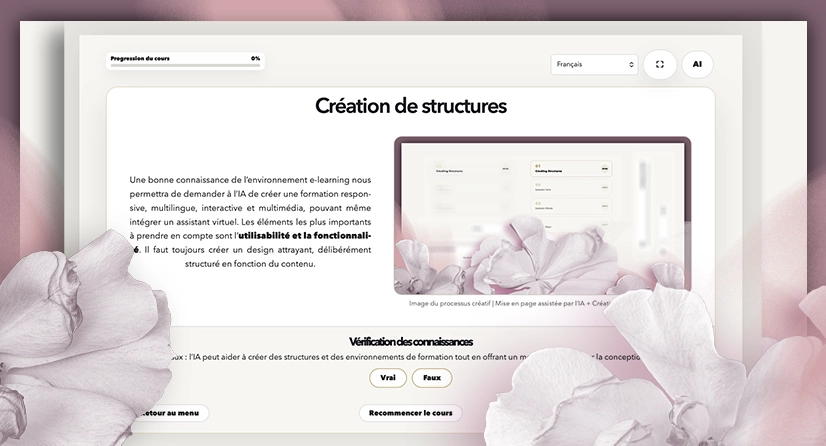
Image du processus créatif | Mise en page assistée par l’IA + Créativité de Houda Bakkali
Vérification des connaissances
Vrai ou faux : l’IA peut aider à créer des structures et des environnements de formation tout en offrant un meilleur contrôle sur la conception du cours.
Vrai ou faux : l’utilisabilité et la fonctionnalité sont moins importantes que le design visuel dans une formation e-learning assistée par l’IA.
Vrai ou faux : l’utilisation de l’IA élimine la nécessité de comprendre la compatibilité avec le LMS, la gestion des apprenants, la sécurité et la confidentialité des données.
Vrai ou faux : la créativité et la signature propre à chaque artiste peuvent apporter une valeur unique et une unité à une expérience de formation.
Il s’agit d’une démonstration bêta montrant comment créer une formation en ligne à l’aide de l’intelligence artificielle, en exploitant le potentiel de cette technologie comme outil auteur personnalisable jusque dans les moindres détails. Dans cet exemple, je montre comment j’ai pu créer, en quelques secondes, un environnement de formation multilingue et interactif, doté d’une barre de progression et d’un assistant IA personnalisé. Cette démonstration nous permettra d’examiner les avantages et les inconvénients de l’utilisation de l’IA comme outil auteur.
L’intelligence artificielle est une alliée précieuse pour améliorer la productivité et automatiser les processus. Elle peut également être utilisée pour créer des structures et des environnements dédiés à la formation. En tant qu’outil auteur, elle nous permet de personnaliser nos formations, tout en bénéficiant d’un meilleur contrôle et d’une plus grande liberté pour structurer et concevoir nos parcours pédagogiques.
Une bonne connaissance de l’environnement e-learning nous permettra de demander à l’IA de créer une formation responsive, multilingue, interactive et multimédia, pouvant même intégrer un assistant virtuel. Les éléments les plus importants à prendre en compte sont l’utilisabilité et la fonctionnalité. Il faut toujours créer un design attrayant, délibérément structuré en fonction du contenu.
L’un des aspects les plus importants lors de l’utilisation de l’IA comme outil auteur pour créer des formations e-learning est de veiller à la compatibilité avec le LMS qui sera utilisé. Il est essentiel de savoir mettre en œuvre tous les aspects techniques, gérer les apprenants et garantir la sécurité ainsi que la confidentialité des données. L’IA peut accélérer la création de formations et nous donner davantage d’autonomie pour concevoir un design adapté à nos contenus. Toutefois, cela ne nous dispense pas d’avoir une connaissance approfondie du fonctionnement de la structure interne de la formation en ligne.
Bien que l’IA puisse accélérer notre travail de manière remarquable et de plus en plus précise, la créativité et la signature personnelle de chaque artiste—ainsi que son design et sa structure visuelle—apporteront une valeur unique et distinctive à chaque contenu pédagogique. La créativité constituera le premier facteur d’impact et le fil conducteur qui unifiera l’ensemble de la formation.
Vrai
Faux
Correct. Vous pouvez continuer.
Ce n’est pas correct. Réessayez.
Continuer
Retour au menu
Recommencer le cours
Voulez-vous recommencer le cours ? Toute la progression sera supprimée.
Question
Concept clé
Assistant du cours
Bonjour. Je peux vous aider à parcourir ce cours de démonstration.
Posez une question…
Assistant de démonstration : l’assistant virtuel sera actif dans le cours réel. Un service/API d’IA externe est nécessaire pour les réponses ouvertes.
Il s’agit d’une démonstration locale sans connexion à une IA externe. Dans le cours réel, l’assistant répondra aux questions sur la leçon.
FAIT
OUVERT
BLOQUÉ
Progresso do curso
IA para e-learning | Houda Bakkali
IA: ferramenta de autoria
Esta é uma demonstração beta de como um curso online pode ser criado utilizando inteligência artificial, aproveitando o potencial desta tecnologia como uma ferramenta de autoria que pode ser personalizada até ao mais ínfimo detalhe. Neste exemplo, mostro como, em apenas alguns segundos, consegui criar um ambiente de aprendizagem multilingue e interativo. Criei este conteúdo 100% com IA e personalizei-o 100% com as minhas próprias obras de arte, como demonstração de como a arte pode ser a primeira interface de impacto e a tecnologia, o motor para criar e expandir o conhecimento. Bem-vindos!
Criação de estruturas
Definição das funcionalidades
Avaliando o LMS
Agregando criatividade
Resumo
A inteligência artificial é uma poderosa aliada para aumentar a produtividade e automatizar processos. Ela também pode nos ajudar a criar estruturas e ambientes para experiências de aprendizagem. Com as ferramentas de autoria, podemos personalizar nossos cursos, obtendo maior controle e liberdade para estruturar e desenvolver nossas formações.
Um bom conhecimento do ambiente de e-learning nos permitirá pedir à IA que crie um curso responsivo, multilíngue, interativo e multimídia, podendo até incluir um assistente virtual. Os aspectos mais importantes a considerar são a usabilidade e a funcionalidade. Devemos sempre criar um design atraente, deliberadamente estruturado em função do conteúdo.
Um dos aspectos mais importantes ao utilizar a IA como ferramenta de autoria para criar cursos de e-learning é garantir a compatibilidade com o LMS que será utilizado. É essencial saber implementar todos os componentes técnicos, gerenciar os alunos e garantir a segurança e a privacidade dos dados. A IA pode agilizar a criação de cursos e proporcionar maior autonomia para desenvolver um design adequado aos nossos conteúdos. No entanto, isso não elimina a necessidade de compreender profundamente o funcionamento da estrutura interna da formação on-line.
Embora a IA possa agilizar nosso trabalho de forma cada vez mais surpreendente e precisa, a criatividade e a assinatura particular de cada artista — seu design e sua estrutura visual — proporcionarão um valor distintivo e único a cada conteúdo formativo. A criatividade será o primeiro fator de impacto e o fio condutor do curso.
Imagem do processo criativo | Diagramação assistida por IA + Criatividade de Houda Bakkali
Verificação de conhecimentos
Verdadeiro ou falso: a IA pode ajudar a criar estruturas e ambientes para experiências de aprendizagem, proporcionando maior controle sobre o design do curso.
Verdadeiro ou falso: a usabilidade e a funcionalidade são menos importantes do que o design visual em um curso de e-learning assistido por IA.
Verdadeiro ou falso: utilizar IA elimina a necessidade de compreender a compatibilidade com o LMS, a gestão dos alunos, a segurança e a privacidade dos dados.
Verdadeiro ou falso: a criatividade e a assinatura particular de cada artista podem proporcionar valor único e unidade a uma experiência de aprendizagem.
Esta é uma demonstração beta de como criar um curso on-line utilizando inteligência artificial e aproveitando o potencial dessa tecnologia como uma ferramenta de autoria que pode ser personalizada nos mínimos detalhes. Neste exemplo, mostro como consegui criar, em poucos segundos, um ambiente de aprendizagem multilíngue e interativo, com barra de progresso e um assistente de IA personalizado. Nesta demonstração, veremos as vantagens e desvantagens de utilizar a IA como ferramenta de autoria.
A inteligência artificial é uma poderosa aliada para aumentar a produtividade e automatizar processos, mas também pode ser utilizada para criar estruturas e ambientes de aprendizagem. Como ferramenta de autoria, permite personalizar nossos cursos, proporcionando maior controle e liberdade para estruturar e desenvolver nossas formações.
Um bom conhecimento do ambiente de e-learning nos permitirá pedir à IA que crie um curso responsivo, multilíngue, interativo e multimídia, podendo até incluir um assistente virtual. Os aspectos mais importantes a considerar são a usabilidade e a funcionalidade. Devemos sempre criar um design atraente, deliberadamente estruturado em função do conteúdo.
Um dos aspectos mais importantes ao utilizar a IA como ferramenta de autoria para criar cursos de e-learning é garantir a compatibilidade com o LMS que será utilizado. É essencial saber implementar todos os componentes técnicos, gerenciar os alunos e garantir a segurança e a privacidade dos dados. A IA pode agilizar a criação de cursos e proporcionar maior autonomia para desenvolver um design adequado aos nossos conteúdos. No entanto, isso não elimina a necessidade de compreender profundamente o funcionamento da estrutura interna da formação on-line.
Embora a IA possa agilizar nosso trabalho de maneira surpreendente e cada vez mais precisa, a criatividade e a identidade particular de cada artista—juntamente com seu design e sua estrutura visual proporcionarão um valor único e distintivo a cada conteúdo formativo. A criatividade será o primeiro fator de impacto e o elemento unificador de todo o curso.
Verdadeiro
Falso
Correto. Pode continuar.
Não está correto. Tente novamente.
Continuar
Voltar ao menu
Reiniciar curso
Deseja reiniciar o curso? Todo o progresso será apagado.
Pergunta
Conceito-chave
Assistente do curso
Olá. Posso ajudar a navegar neste curso de demonstração.
Faça uma pergunta…
Assistente de demonstração: o assistente virtual estará ativo no curso real. É necessário um serviço/API de IA externo para respostas abertas.
Esta é uma demonstração local sem ligação a uma IA externa. No curso real, o assistente responderá a perguntas sobre a lição.
FEITO
ABERTO
BLOQ.
Progreso del curso
IA para e-learning | Houda Bakkali
IA: herramienta de autor
Esta es una demostración beta de cómo se puede crear un curso online con Inteligencia Artificial, haciendo uso del potencial de esta tecnología como herramienta de autor que podemos personalizar hasta el más mínimo detalle. En este ejemplo muestro como, en pocos segundos, pude crear un contenedor formativo multilingüe, interactivo, con barra de progreso y con un asistente personalizado de IA. En esta demo vamos a ver los pros y contras de usar la IA como una herramienta de autor. ¡Bienvenidos!
Creación de estructuras
Definiendo funcionalidad
Valorando el LMS
Aportando creatividad
Resumen
La Inteligencia Artificial es una poderosa aliada para favorecer productividad y automatizar procesos, pero también lo es para crear estructuras y contenedores para la formación. Una herramientas de autor que podemos personalizar nuestro curso, teniendo un mayor control y una mayor libertad a la hora de estructurar el diseño de nuestras formaciones.
Conocer bien el entorno e-learning nos dará competencias para pedirle a la IA un curso responsive, multilingüe, interactivo, multimedia e incluso con asistente virtual. Lo más importante es tener en cuenta la usabilidad y la funcionalidad, y siempre crear un diseño atractivo pero que esté deliberadamente estructurado en función del contenido.
Uno de los aspectos más críticos a la hora de usar la IA como herramienta de autor para crear cursos e-learning es tener en cuenta la compatibilidad con el LMS que vamos a usar. Saber implementar toda la parte técnica y gestión del alumnado, así como atender a la seguridad y privacidad de datos. La IA nos puede agilizar la creación de cursos y nos da autonomía para crear el diseño que mejor se adapte a nuestros contenidos, pero esto no excluye que tengamos que tener una conocimiento profundo de cómo funciona la estructura interna de la formación online.
Si la IA nos pude agilizar de manera sorprendente, ya cada vez más acertada, la creatividad y el sello particular de cada artista, su diseño y estructura visual, serán un gran valor distintivo y único para cada contenido formativo. La creatividad será el primer factor de impacto y eje de unión del curso.
Imagen del proceso creativo | Maquetación con IA + Creatividad Houda Bakkali
Comprobación de conocimientos
Verdadero o falso: la IA puede ayudar a crear estructuras y contenedores para la formación, proporcionando un mayor control sobre el diseño del curso.
Verdadero o falso: la usabilidad y la funcionalidad son menos importantes que el diseño visual en un curso e-learning asistido por IA.
Verdadero o falso: utilizar IA elimina la necesidad de comprender la compatibilidad con el LMS, la gestión del alumnado, la seguridad y la privacidad de los datos.
Verdadero o falso: la creatividad y el sello particular de cada artista pueden aportar un valor único y unidad a una experiencia de aprendizaje.
Esta es una demostración beta de cómo se puede crear un curso online con Inteligencia Artificial, haciendo uso del potencial de esta tecnología como herramienta de autor que podemos personalizar hasta el más mínimo detalle. En este ejemplo muestro como, en pocos segundos, pude crear un contenedor formativo multilingüe, interactivo, con barra de progreso y con un asistente personalizado de IA. En esta demo vamos a ver los pros y contras de usar la IA como una herramienta de autor.
La Inteligencia Artificial es una poderosa aliada para favorecer productividad y automatizar procesos, pero también lo es para crear estructuras y contenedores para la formación. Una herramientas de autor que podemos personalizar nuestro curso, teniendo un mayor control y una mayor libertad a la hora de estructurar el diseño de nuestras formaciones.
Conocer bien el entorno e-learning nos dará competencias para pedirle a la IA un curso responsive, multilingüe, interactivo, multimedia e incluso con asistente virtual. Lo más importante es tener en cuenta la usabilidad y la funcionalidad, y siempre crear un diseño atractivo pero que esté deliberadamente estructurado en función del contenido.
Uno de los aspectos más críticos a la hora de usar la IA como herramienta de autor para crear cursos e-learning es tener en cuenta la compatibilidad con el LMS que vamos a usar. Saber implementar toda la parte técnica y gestión del alumnado, así como atender a la seguridad y privacidad de datos. La IA nos puede agilizar la creación de cursos y nos da autonomía para crear el diseño que mejor se adapte a nuestros contenidos, pero esto no excluye que tengamos que tener una conocimiento profundo de cómo funciona la estructura interna de la formación online.
Si la IA nos pude agilizar de manera sorprendente, ya cada vez más acertada, la creatividad y el sello particular de cada artista, su diseño y estructura visual, serán un gran valor distintivo y único para cada contenido formativo. La creatividad será el primer factor de impacto y eje de unión del curso.
Verdadero
Falso
Correcto. Puedes continuar.
No es correcto. Inténtalo de nuevo.
Continuar
Volver al menú
Reiniciar curso
¿Quieres reiniciar el curso? Se borrará todo el progreso.
Pregunta
Concepto clave
Asistente del curso
Hola. Puedo ayudarte a navegar por este curso de demostración.
Haz una pregunta…
Asistente de demostración: el asistente virtual estará activo en el curso real. Se necesita un servicio/API de IA externo para respuestas abiertas.
Esta es una demostración local sin conexión a una IA externa. En el curso real, el asistente responderá preguntas sobre la lección.
HECHO
ABIERTO
BLOQ.

 Houda Bakkali Art
 Image of the creative process | AI-assisted layout design + Creativity by Houda Bakkali